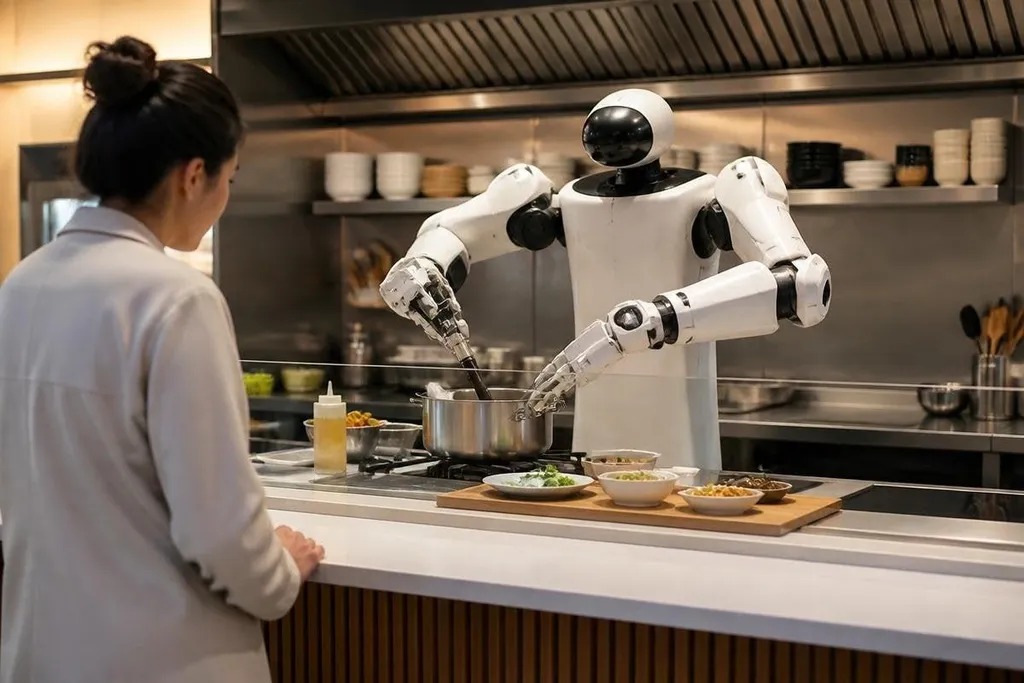
A robot chef can chop vegetables, control heat, and place food on a plate. People still judge it as if it has a role in the kitchen, not only a set of motors and sensors. That judgment shapes trust, appetite, and the willingness to let the machine handle dinner.
Quick read
- Visible control over heat, timing, and ingredients makes the machine easier to trust.
- Human-like movement can help at first, then unsettle people when the robot misses a task.
- Clean handoffs, clear limits, and a way to stop the machine matter more than a polished demo.
The kitchen makes the reaction personal
Food carries more meaning than many household tasks. When it moves a box, the robot deals with an object. When it prepares soup, the robot handles something people will eat, and that brings safety, taste, care, and habit into the decision.
The machine’s actions also happen in a familiar human setting. Kitchens contain knives, heat, spills, and tight spaces. People already know what a careful cook should do, so they compare the robot’s movements with that mental picture. A pause near a hot pan may look careful. The same pause beside a cold bowl may look like a fault.
This is where perceived agency enters. People may treat the robot as if it has a reason for each action, even when its software is following fixed rules. A quick arm movement can read as confidence, while a repeated failed grip can make the whole system seem less capable than its actual cooking task requires.
Human-like motion can help, then hurt
The robot chef does not need a face to seem human. Its speed, posture, and hand movements can create that impression. Smooth motion may make the machine easier to watch, while stiff or poorly timed movement reminds people that a control system is doing the work.
That effect can reverse when the robot looks too human but behaves poorly. The mismatch creates discomfort: the machine appears ready to understand a kitchen, then drops an ingredient or reaches for the wrong tool. This is often called the uncanny valley, a term for the uneasy response caused by an almost-human appearance that misses expected behavior.
The safer design choice may be modest movement with clear signals. If the robot turns toward a hot surface, waits for a sensor check, and shows why it stopped, it gives people useful information. The action does not need to look human. It needs to make sense.
Trust grows from visible limits
Trust in a robot chef is built through small signs of control. People want to know how it checks food temperature, spots an object in its path, and handles an ingredient that is missing from its expected position.
A clear stop button matters for the same reason. So does a visible status signal that separates “heating,” “waiting for an ingredient,” and “fault.” These details let a person form a working model of the robot. They can predict what happens next instead of guessing.
Trust grows when reports show what a robot chef does during real kitchen work. Robot chef reporting from Robot24.com can connect the cooking task to its safety controls and visible limits, giving you evidence for how people may judge the machine.
The food itself adds another test. The robot may repeat a recipe with steady timing, yet people can still reject the meal if the process looks dirty, wasteful, or hard to inspect. Ingredient storage, surface cleaning, and handoff to the plate may shape opinion as much as the robot arm.
The human role still sets the tone
People react differently when they remain in control. Choosing the recipe, loading ingredients, checking the finished food, or stopping the cycle gives the robot a supporting role. A machine that removes every visible decision can feel harder to trust, even when it completes the task faster.
I’d judge a robot chef by the quality of its handoff to a person. The strongest design leaves clear points for inspection: the ingredient list, the cooking state, the reason for a pause, and the final plate.
That standard also changes how companies should present robot chefs. A short demo can show a clean motion, but it cannot answer how the system deals with a wet counter, a missing ingredient, or a person reaching into the work area.
Those cases reveal the machine’s real limits.
A practical trust check
Before accepting a robot chef for regular use, check these points:
- Watch the stop behavior: confirm that the robot pauses safely when a person enters its work area.
- Check food handling: look for clear steps for storage, surface cleaning, temperature checks, and cross-contact risks.
- Test the handoff: see how the robot reports a missing ingredient, blocked tool, or failed grip.
- Read the control path: identify who can change recipes, approve a cycle, and stop the machine.
- Compare the task: decide if automation solves a repeated kitchen job or adds more setup than it removes.
The next useful test is not a smoother arm movement. It is a full cooking cycle with a missing ingredient, an unexpected interruption, and a person who needs to stop the robot quickly.